Comparison of 4 Ni-Hard Alloys
on June 2, 2026
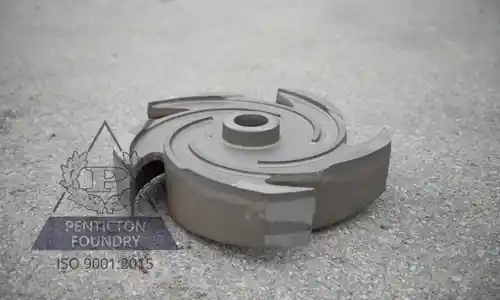
This blog compares 4 Ni-Hard alloys, examining chemical composition, potential applications and toughness notes.
Ni-Hard is an abrasion resistant material that uses nickel as the main hardenability element. The addition of chromium forces metal carbides to form (as opposed to graphite). This results in a microstructure made up of austenite and carbides throughout the casting, regardless of section thickness. During the natural cooling process, the austenite transforms primarily to martensite. The final microstructure consists of M3C carbides and martensite, with some retained austenite.
Note: Thick castings may also contain a little pearlite.
Chemical Composition of Ni-Hard Alloys
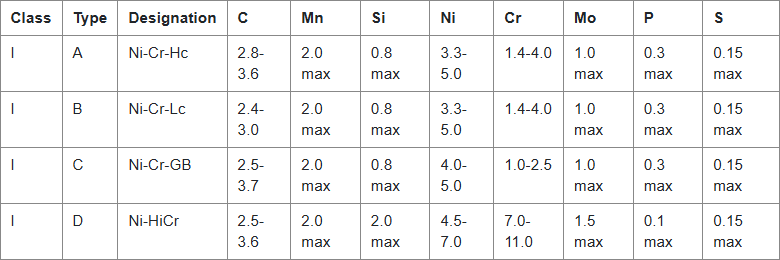
ASTM A532 Class I Type A Ni-Cr-Hc
- Commonly referred to as Ni-Hard or Ni-Hard 1 or Ni-Hard Type A
- The most specified Ni-Hard alloy
- Works well in wet or dry conditions
- Can handle some impact, but no strong corrosion resistance
- Supplied in a hardness of ~ 550 – 690 BHN, depending on section thickness
- Can be used in the as-cast condition
- Less expensive than most high chrome white irons, unless the price of nickel is high
- Readily accepts cast-in inserts, which makes machining easier
- Successfully used in applications like bucket teeth and lip liners
- Longstanding use in steel mill rollers - “indefinite chill” Ni-Hard used as an outer shell, with ductile iron forming the inside body and the necks
- Used in liners for concrete processing
Read: This resource compares ASTM A532 Class 1 Type A to ASTM A532 Class 2 Type D in more detail.
ASTM A532 Class I Type B Ni-Cr-Lc
- Lower carbon than Class 1 Type A
- Contains less carbides
- More toughness than Class 1 Type A
- Typically specified for thinner section castings
- For thinner sections, less nickel is needed
- Used in similar applications as Ni-Hard Type A, but a better choice when a little more toughness is required.
- An option for thin liners, like those found in mobile recycling machines, where weight is an issue
ASTM A532 Class I Type C Ni-Cr-GB
- Included for historic reasons only
- Used to be the alloy selected for grinding balls for the mining industry
- Not normally specified for any abrasion resistant applications
Read: To understand why people are switching from Ni-Hard alloys to high chrome white iron alloys, read “Why People are Changing from Ni-Hard to Chrome White Iron.”
ASTM A532 Class I Type D Ni-HiCr
- Increased amounts of nickel and chromium, which promotes M7C3 carbides
- Added expense due to the increase in alloy content
- Improved toughness and abrasion resistance over Ni-Hard Type A
- The alloy solidifies in an almost-eutectic fashion, and the higher silicon improves fluidity
- Its good fluidity makes this alloy easy to cast into intricate shapes
- As-cast hardness ~ 600 BHN
- Possible to heat treat to ~ 700BHN
- Responds well to cryogenic heat treatment, although hardness doesn’t change dramatically
- Can be used in complex pump casings and impellers for applications like sewage treatment
Read: To learn more about chrome white iron, check out our chrome white iron webpage